Sympathy and funeral flowers, done with care
Where to send sympathy flowers, which arrangements suit a service or a home, and the faith traditions where flowers are not the custom.
Updated November 1, 2026
Choose a bouquet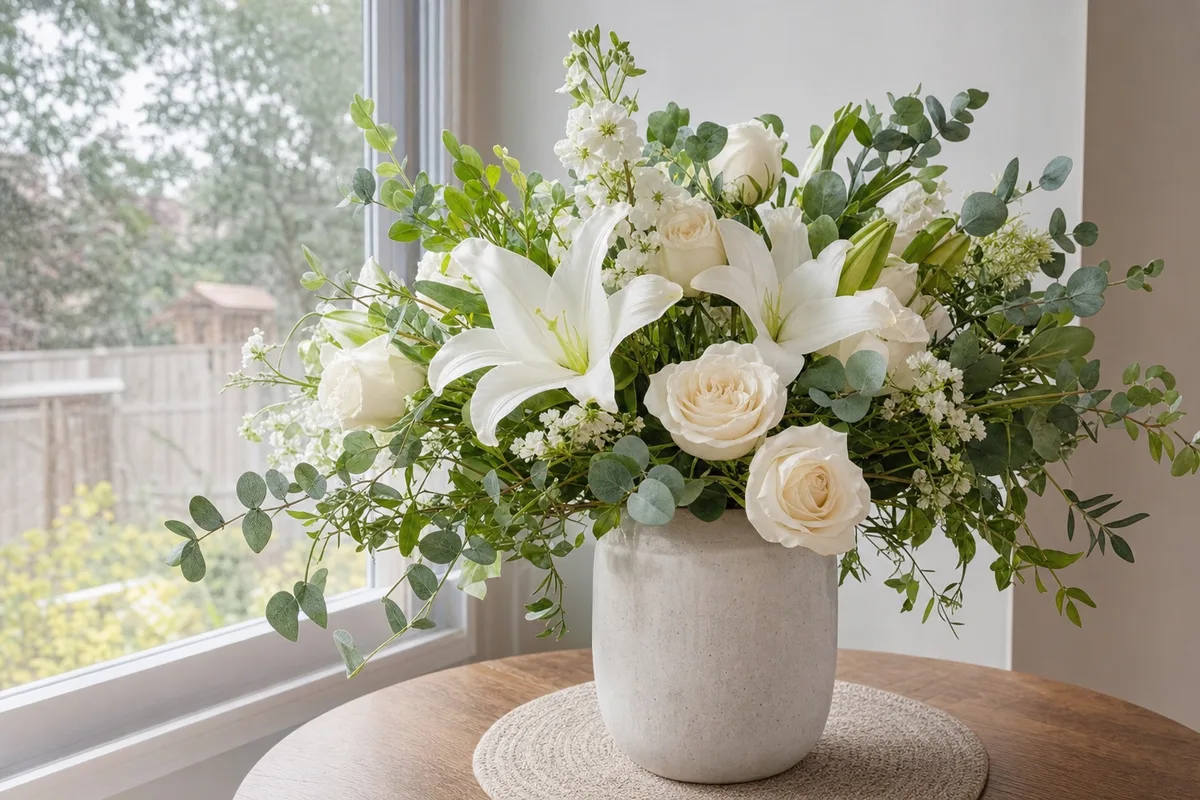
When someone dies, flowers are one of the oldest ways to say "I'm sorry" without needing the right words. They can also go wrong in quiet ways: a towering spray delivered to a small apartment, a bouquet arriving at a funeral that ended yesterday, or flowers sent to a family whose faith does not use them. Here is how to get the choice, the address and the timing right.
Read the obituary before anything else
The obituary or the funeral home's online notice usually answers your first three questions: where the service is, when it is, and what the family wants. Look for the phrase "in lieu of flowers." When a family asks for donations to a charity or a cause instead, honor that. A gift to the named organization, with a note to the family that you gave in the person's memory, is the right gesture. If the notice says nothing either way, flowers are generally fine.
When there is no public notice, ask someone close to the family, or call the funeral home directly. Funeral directors field these questions daily and will tell you whether flowers are being accepted, the latest time they can arrive, and whether the family has a preference.
Three destinations, three kinds of flowers
To the funeral home or place of service
Arrangements sent here are on display during the visitation, wake or service, so they are larger and built to stand. This is where standing sprays, wreaths on easels and floor baskets belong. Addressing is simple: the funeral home name and address, the deceased's full name, and the date and time of the visitation. Ask the florist to deliver a few hours before viewing begins so staff have time to place everything.
To the family's home
Flowers going to a house are for the grieving people, not the ceremony. Choose something that fits on a kitchen table and does not require a stand. A modest vase arrangement or a living plant is ideal. Plants such as peace lilies, orchids or a small green garden last for weeks and keep reminding the family that people care, long after the service flowers are gone. If the family has cats, skip true lilies, which are highly toxic to them.
To a church, synagogue, mosque or other venue
Houses of worship sometimes have their own rules on outside flowers, where they may be placed, and who removes them afterward. Check with the venue or the funeral director before sending anything there.
Standing sprays, wreaths and arrangements
| Type | Who usually sends it | Where it goes |
|---|---|---|
| Casket spray | Immediate family (spouse, children) | On top of the casket |
| Standing spray or easel wreath | Extended family, close friends, employers, groups | Funeral home or service, beside the casket or urn |
| Floor basket or large arrangement | Friends, coworkers, neighbors | Funeral home or service |
| Vase arrangement | Anyone | Service or family home |
| Living plant | Anyone, often close friends | Family home |
As a guest you should not send a casket spray; that piece is traditionally ordered by the closest relatives. A group, such as an office or a club, often pools together for one standing spray, which looks generous and spares the family a crowd of small pieces. Large tributes are awkward at a home, so keep them for the service.
Religious and cultural customs
Customs vary widely, even within one faith, and individual families make their own choices. Use this as a starting point and confirm with the family or the funeral home.
- Jewish tradition. Flowers are generally not part of Jewish funerals or the shiva period that follows. Families often prefer a donation in the person's memory, or food sent to the shiva house. Some less traditional families do welcome flowers, so ask.
- Muslim tradition. Burial usually happens very quickly, often within a day, and many families keep the funeral simple. Practices on flowers differ between communities. Donations, food for the family or a visit are safe choices; check before sending flowers.
- Catholic and most Protestant traditions. Flowers are common at the wake, the funeral and the graveside. Some churches limit what can be placed in the sanctuary during the funeral Mass.
- Hindu tradition. Families may welcome garlands or simple flowers, often in white, but large formal displays are less usual. Ask the family.
- Buddhist tradition. White flowers are customary in many communities; bright red can be seen as a color of celebration and is usually avoided.
When in doubt, a handwritten note and a meal for the family are welcome in nearly every tradition.
Choosing flowers and colors
White is the classic color of sympathy across many cultures and never looks out of place. Soft pastels, blues and lavender feel gentle and calm. Many families now ask for flowers that reflect the person, so bright sunflowers for someone who loved the garden, or the deceased's favorite color, can be a lovely touch when you know it was theirs. Common choices include lilies, roses, carnations, chrysanthemums, gladiolus, hydrangeas and orchids. Chrysanthemums deserve a note: in parts of Europe and Asia they are mainly a funeral flower, while in the US they are often used for cheerful occasions too.
Timing
- For the service: order as soon as you know the date, ideally a day ahead. Delivery should arrive before the visitation opens. If the funeral is tomorrow morning, look at our same-day cutoffs guide and order early in the day.
- To the home: any time in the first days is fine. Families are often busy and surrounded by people during the first week.
- Late is not too late. A plant or bouquet two or three weeks later, or on the first birthday or anniversary after the death, often means more because the visitors have gone home.
If you missed the service entirely, do not send a funeral piece to the funeral home. Send something modest to the home with a note that you just heard and are thinking of them.
What to write
The card on a funeral arrangement is read by the family, often later, when they are writing thank-you notes. Include your full name, and for a group, the name of the organization. Keep the message short:
- "With deepest sympathy. Remembering David with love, the Martinez family."
- "She made our street a kinder place. We are so sorry. Ann and Lou Becker."
- "Holding you close in our thoughts. Your friends at Harbor Dental."
Avoid explaining the loss ("everything happens for a reason") or comparing it to your own. A single true sentence about the person is the most valued thing you can write. Our guide on what to write on the card has more examples for different relationships.
Before you place the order
- Confirm the family accepts flowers and has not asked for donations instead.
- Confirm the destination: funeral home, home or venue.
- Match the size to the destination: standing pieces for services, vases and plants for homes.
- Give the deceased's full name and the service date and time on the order.
- Sign the card clearly so the family knows who to thank.
Ready to send?
Order by 2 p.m. in their time zoneA local florist near the person you're sending to arranges the bouquet and delivers it the same day.
See today's bouquets
Common questions
Is it rude to send flowers when the family asked for donations?
It goes against their stated wish, so donate to the cause they named instead. You can still send a card telling them you gave in the person's memory.
Can I send sympathy flowers to a coworker's office?
It is better to send them to the home or the service. A coworker who is grieving may not want a visible reminder at their desk, and they may be out for several days.
Should flowers go to the cemetery?
Arrangements are usually moved from the service to the graveside by the funeral home. Sending directly to a cemetery is uncommon; ask the funeral director if you want flowers at the burial.
What if I only learn about the death months later?
Send a short note and, if you like, a small plant or bouquet to the home. Families often say late messages comfort them because the attention fades so quickly after the funeral.